
High profits don’t necessarily lead to high investment
When investors see a highly profitable industry with enormous growth opportunities, rising capital spending can feel almost inevitable.
History suggests otherwise.
Across the industries we study, companies appear to invest most aggressively not when profits are highest, but when public markets place the highest value on incremental investment.
The distinction matters. A management team is much more likely to spend another dollar when investors appear willing to value that dollar at several times its cost.
Tech itself is a good example
For much of the last two decades, Big Tech combined extraordinarily high returns on invested capital with relatively modest asset growth. The sector became famous for being capital-light.
That relationship is now changing.
AI investment has pushed Tech toward a dramatically more capital-intensive model. In 2026, a relatively small group of large technology companies is expected to spend roughly four times as much as the Energy Infrastructure, Natural Resources and MLP sectors combined.
Why now?
Our historical work suggests that valuation provides an important part of the answer. Tech capital spending has shown a much stronger relationship with valuation than with prior-year profitability.
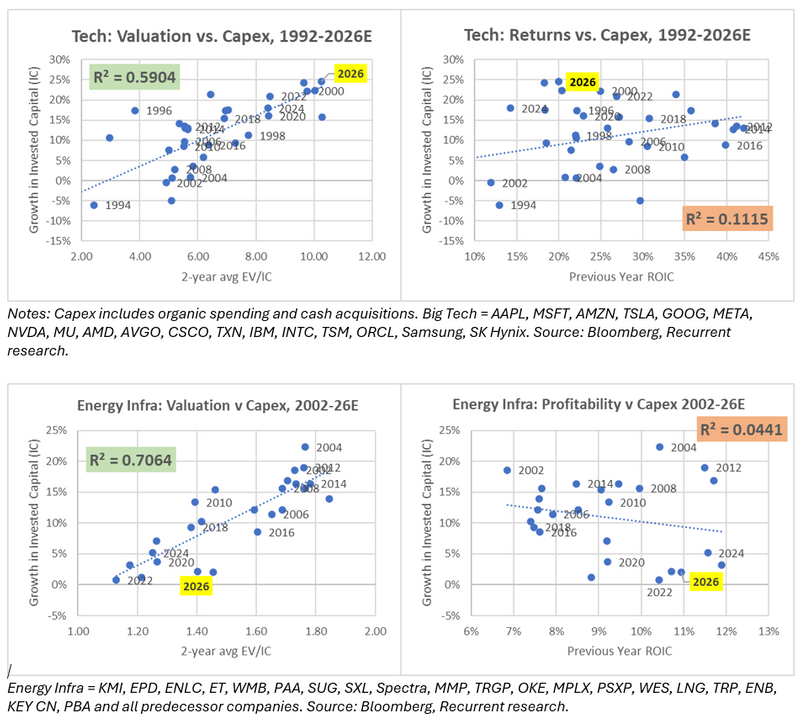
Historically, capex has tracked valuation much more closely than profitability
The pattern isn’t unique to Tech
Energy Infrastructure looks fundamentally different from technology, but the capital-allocation pattern is remarkably similar.
Today, Energy Infrastructure is generating historically strong returns on capital while growing its invested capital base only modestly. Low valuations have encouraged management teams to emphasize free cash flow and distributions rather than aggressive expansion.
We find the same broad pattern in oil and mining: valuation has historically been much more closely related to subsequent investment growth than profitability has.
In other words, high returns do not automatically create new supply.
High valuations make new supply easier to finance — and make management teams more willing to build it.
Why this matters for investors
Capital cycles eventually reshape industries.
Railroads, fiber optics, merchant power, mining, Shale, pipelines and renewable power have all experienced periods when abundant capital encouraged rapid expansion — often followed by falling returns and greater cyclicality.
Today’s AI boom raises the same question for Tech.
At the same time, lower valuations across many commodity and infrastructure businesses continue to discourage investment despite strong profitability.
That contrast is central to how we think about future market structure.
If valuations determine where capital flows, understanding what investors are willing to finance today can help tell us what will become abundant — and what may remain scarce — tomorrow.
This research note is adapted from Recurrent's January 2026 monthly investment commentary.