
Energy prices are rising again. But the world is not short of oil and gas.
For oil and US natural gas - two commodities where marginal supply is set by US Shale - prices have remained subdued. Meanwhile, for gasoline, diesel, European power and gas, fertilizer, steel and other energy-intensive products - which rely on long-dated capex for marginal supply - prices have risen sharply.
The disconnect is the point.
The world appears to have plenty of raw energy. What it increasingly lacks is the infrastructure required to turn that energy into usable products.
Shale solved one problem — but not the other
For much of modern oil-market history, meaningful new supply required projects with long development timelines. Offshore and conventional developments could take years from investment decision to first production.
US Shale changed that structure.
In research going back a decade, we argued that Shale’s unusual combination of high marginal costs and rapid response times had transformed oil into a much shorter-cycle commodity. When prices rise, drilling can increase. When prices fall, drilling can decline.
The result has been striking. Despite COVID, wars, sanctions and repeated geopolitical disruptions, oil has remained inside our Shale-defined price range roughly 90% of the time since 2015.
But the ability to rapidly produce another barrel of oil does not mean the world can rapidly build another refinery, LNG export terminal, long-haul pipeline, power plant or smelter.
And that is increasingly where the constraint lies.
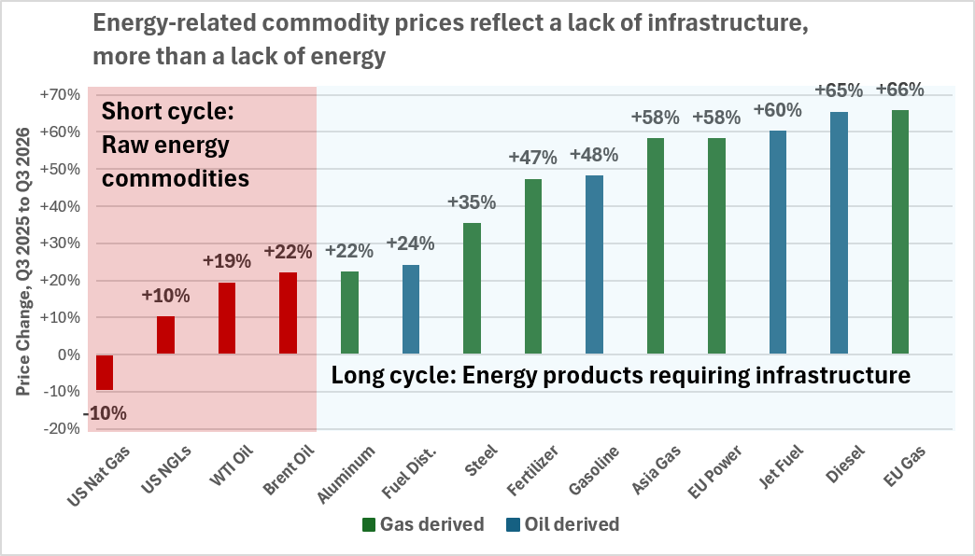
Short-cycle U.S. natural gas, NGL and crude-oil prices have remained comparatively stable, while products dependent on long-cycle infrastructure have experienced substantially larger price increases.
Data as of August 14, 2026. Source: Recurrent research, public filings, Bloomberg.
Short-cycle supply meets long-cycle infrastructure
The chart illustrates a striking split.
On the left are raw energy commodities that can increasingly respond to short-term price signals. Shale producers can add rigs when economics improve and reduce activity when economics deteriorate.
On the right are products whose supply depends on infrastructure requiring years of planning, permitting, engineering and construction.
That difference in response time is critical.
A producer considering a new Shale well can react to today’s commodity environment. A company considering a new refinery, LNG plant, pipeline, power plant or smelter must make a very different decision: commit substantial capital today based on an expectation that market conditions will remain attractive for decades.
A six-month price spike is not enough to justify a twenty-year investment.
That helps explain the unusual energy market we see today. The raw commodities themselves can remain relatively well supplied even while the infrastructure needed to process, transport and transform those commodities becomes increasingly scarce.
The investment implication: follow the chokepoint
Energy investors have traditionally focused on the price of the underlying commodity: Will oil rise? Will natural gas fall? Will OPEC cut production?
Those questions matter. But if raw commodity supply is increasingly responsive to price, while infrastructure remains slow and capital-constrained, then value will continue to accrue to bottlenecks, instead of the energy molecule itself.
Instead of simply asking where oil or natural gas prices are headed, investors should ask: where does abundant raw energy encounter scarce infrastructure?
Pipelines, refineries, LNG facilities, power plants and other hard-to-replicate assets sit at those chokepoints. Today’s energy inflation is showing their value in real time. The world may have enough energy molecules; what it increasingly lacks is the infrastructure required to put them to work.